

Exercise Equipment to Give Your Whole Body a Workout
If you've ever been to a professional gym you've probably seen equipment that lets you give your whole body a workout. The equipment ranges from heavy-duty professional equipment to small machines that are able to be used at home.
No matter what type of equipment you use, always "bake-in" progression and regression to aid your clients or students improve their fitness. Remember that even the best equipment will only produce results if it is used regularly.
All-in-One Exercise Systems
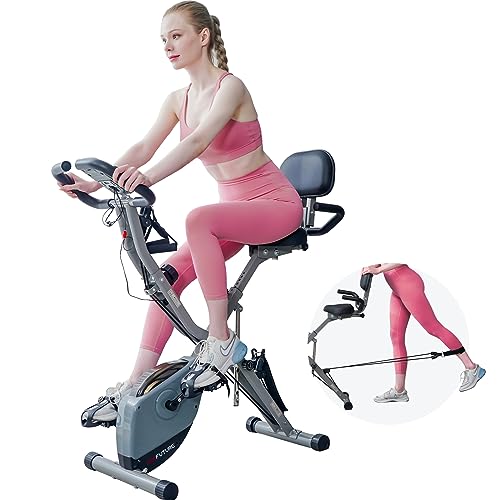
All-in-one exercise systems combine the capabilities of several pieces of equipment into a single unit. They typically include an squat rack and bench to help with strength training, as well as various attachments to perform a variety of exercises to target muscles in the arms, shoulders back, abdomen, and legs. They might also include cables and pulleys which provides resistance to help you train weights. Some all-in-one exercise systems, such as the Life Fitness G7 Home Gym come with an adjustable resistance system which allows you to change the amount of weight you're using by simply getting up from your seat. Some of these machines can be folded or put away to save space.
Some all-in one exercise systems make use of a polymer rod referred to as Power Rods to create tension instead of traditional iron weights. All-in-one models like the Total Gym and Bowflex systems use this type of technology. These systems allow you to exercise your entire body without the use of weights. However, they do require that you perform some exercises for strength using your own body weight.
talks about it -in one exercise systems combine both weights and an incline pulley system and cable such as the BodyCraft X3 System. It comes with two 200-pound weight stacks that enables you to do many different strength-training exercises. It also has a wide selection of attachments, such as bars that are long and short with double and single D-handles, ankle straps stirrup handles, a rope handle and dual arm cuffs.
Other all-in-one exercise equipment, like the Tonal and Tempo Studio, include technology that helps to ensure proper form during your exercise routine. Both systems use 3D sensor technology to monitor 25 joints, compare them to reference points such as mirrors, and identify when your form has changed. The products then provide real-time feedback that will help you get back into proper posture. This feature can reduce your risk of injury and ensure that you are targeting the right muscles in the most effective way possible. This is especially important when training athletes for sports. If you're doing an upper-body exercise that is linked to running blocking, for instance it is important to ensure you're targeting the muscles needed by the sport.
Weights
Weight training helps build muscles, strengthens bones, and improves balance, as well as burns calories. Athletes can train using free weights (dumbbells, barbells) or machines that offer guided movement patterns or cables with handles and bars for various pull exercises. Resistance bands provide resistance to bodyweight exercises and are a great way to incorporate them into workouts for children athletes or those without access to weights.
When using weights, coaches must avoid putting young athletes in low rep ranges which can lead to injuries and muscle soreness. High and middle school should use weights they can lift more than six times with proper form.
Resistance Bands or Tubing
Tubing and resistance bands provide a versatile alternative to weight training. They're utilized by professional athletes in all sports - footballers, UFC fighters, bodybuilders, and more - to boost performance as well as increase strength and power and increase muscle mass without the need for heavy free weights.
Since nearly a century elastic resistance training has been practiced for a long time. Athletes of all ages, fitness levels, and genders benefit from elastic resistance training to improve muscle strength, speed and agility. Tubes and bands for resistance are affordable and easy to carry, and they can be paired with simple home exercises to complete a fitness routine.
Flat resistance bands are strips of latex, or stretchy fabrics. They are equipped with handles on both ends. When not in use they can be folded and stored in bags or backpacks. They are lighter than tubes resistance band and can be used for more exercises.
Tube resistance bands are hollow, cylindrical tubes made of an elastomer or plastic compound. They are designed to be affixed to a door, bar or pole or any other stationary object. These bands can be utilized for pulling or pushing exercises, and they provide varying levels of resistance depending on their thickness and tension. They're also more resilient than flat resistance bands and often feature a built-in snap guard that safeguards against over-stretching and injury.
The most significant benefit of elastic resistance training is the ability to change the direction of the pull during an exercise. For instance, a study performed at Brigham Young University showed that changing the direction of force during the squat exercise or step by redirecting the tubing or band towards the front of your leg could alter the focus on muscles of the quad and hamstring.
A resistance band or tubing can be an ideal option for those who prefer to work on their own instead of working with a trainer or group. You can also take them along when you travel because they are small enough to fit into a backpack or suitcase.
Aerobic Machines
Exercises that increase endurance and strength of the cardiovascular system. They also help in burning calories and release a feeling-good chemical known as endorphins. The most popular types of cardiovascular exercise include walking, jogging, using an elliptical machine, riding a stationary bike and climbing on a stair climber. Although these workouts can be done outdoors but indoor gym equipment is often used for a variety reasons. Cardio equipment has the primary advantage of providing an environment that is controlled and allows for a custom-designed exercise. A lot of machines have built-in monitors to track heart rate as well as time and distance to provide an improved workout experience.
Treadmills offer a low-impact cardio workout and can be used to simulate running, walking or climbing stairs. They also let users control their pace, incline and resistance level. These features make treadmills a great option for those with knee problems or wish to get fit.
Stair climbers are popular pieces of equipment for cardio as they work both upper and lower body at the same time while burning off a lot of calories. Designed to mimic a never-ending climb up a flight of stairs, stair climbers strengthen the legs and core while focusing on muscles in the back, arms and shoulders.
The Jacob's Ladder is a unique piece of fitness equipment that offers a demanding, total-body workout. This unique piece of equipment is designed to look like a ladder with separate rungs which serve as foot platforms. The rungs are linked to a chain that moves continuously as the user climbs. This makes the ladder move according to the user's speed of climbing and allows them to select their own intensity.
Stationary bikes and ellipticals are another popular kind of cardio equipment due to their low-impact, full-body cardiovascular exercise. These machines allow users to alter their resistance levels to focus on specific muscles. For example, some ellipticals come with the "Rolling Hills" program that adjusts the resistance of the machine to simulate running or biking up hills. Other ellipticals and stationary bikes come with interval training programs to increase endurance.